Industrial maintenance, also known as plant maintenance, is a type of planned or preventive maintenance designed to increase equipment uptime in a manufacturing environment. The ultimate goal is to ensure every plant asset is in peak operation condition, while ensuring production runs smoothly at the lowest possible cost.
Without an industrial maintenance plan, it is virtually impossible to meet production quotas at a reasonable cost. Unscheduled breakdowns or suboptimal equipment performance will reduce productivity and create delays. The alternative to plant maintenance is performing corrective maintenance after a breakdown has occurred and relying on contractors to repair equipment on a reactive basis. This approach quickly becomes expensive in terms of labor costs and lost revenue from unscheduled downtime.
What Are The Benefits of Industrial Maintenance?
Prevent catastrophic failures before they occur
Predict ongoing maintenance needs (leads to more coordinated maintenance management and workforce planning)
Improve reliability and availability of plant automation systems, including machinery and processes
Implement industrial maintenance programs designed to reduce inspection time, improve plant operating performance, cut costs and boost safety
Keep all productive assets in good working condition
Reduce total maintenance costs
Reduce revenue loss due to production stoppage
The best way to keep maintenance costs down is to set maintenance KPIs and implement the right mix of maintenance strategies supported by mobile maintenance software.
How to Create an Industrial Maintenance Strategy
1. Run a Proactive Maintenance Program
Your first step should be to put your most critical assets on a preventive maintenance plan. This means regularly scheduling maintenance even if the asset appears to be in working condition, in order to prevent an unanticipated breakdown in the future. PM plans can be calendar-based or meter-based. Calendar-based maintenance occurs at regular time intervals, while meter-based maintenance is scheduled once a certain meter reading is detected.
2. Use Industrial Maintenance Software
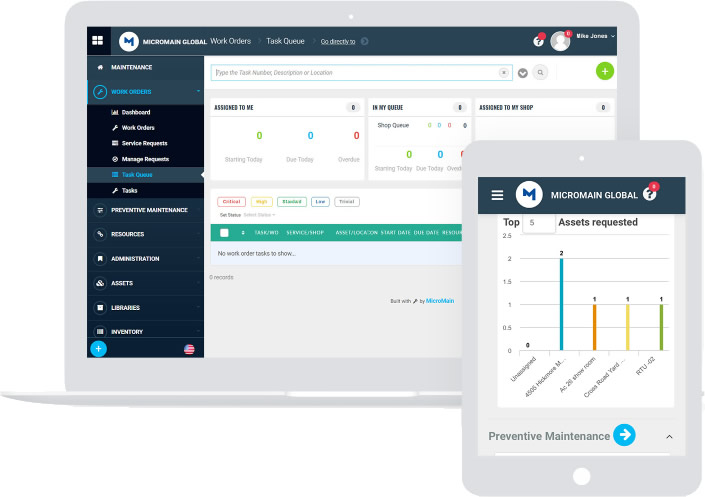
Proactive maintenance involves relying on automations like automatic meter readings and historical data to predict when an asset is about to fail and schedule maintenance accordingly. It is virtually impossible to run a programmed industrial maintenance strategy successfully without the help of industrial maintenance management software like MicroMain’s Mobile CMMS. With a CMMS, you can:
Assign and track work orders
Set priorities, due dates and alerts
Store OEM requirements and warranties for easy access
Schedule regular maintenance tasks and track historical asset life cycle data.
The main benefit of having a mobile CMMS like MicroMain is your technicians can work from anywhere, receive notifications for new work orders, and vastly increase their wrench-on time.
3. Define Clear Procedures
Industrial maintenance managers need to set clear expectations and procedures so that technicians not only know when to perform maintenance, but how to do it. These procedures include:
Standard Operating Procedures (SOP)
Emergency Operating Procedures (EOP)
Preventive maintenance checklists
OSHA guidelines.
4. Refine Your Approach
Let the data be your guide. Industrial maintenance technology isn’t a set-it-and-forget-it solution. Managers need to define maintenance KPIs, use a CMMS to track metrics, generate reports and make changes if the numbers show that you are not hitting your maintenance goals. Here’s where a CMMS becomes vital.
How a CMMS Can Help With Industrial Maintenance
Streamline the Reporting Process
A CMMS provides a fast and easy way for machine operators and other employees to report problems. Create an online form where people can submit a ticket, which will be managed and overseen by the maintenance team.
This prevents technicians from receiving work request phone calls while they’re in the middle of other important work, with no paper or digital trail to keep track of scheduling.
Customize the form by allowing users to submit photos and indicate task priority as well as identifying information such as building number (in a large facility) and equipment type. Doing so standardizes work order requests, prevents ambiguities and enables maintenance planners to triage corrective tasks more effectively all of which are critical in industrial maintenance.
Optimize the Workflow
Create a set of standard maintenance procedures technicians can follow when dealing with complex assets. Even if these assets aren’t currently under a preventive maintenance plan, you can still minimize downtime and maintenance costs by preparing for the asset’s eventual degradation.
CMMS features help facilitate this process by providing quick access to maintenance logs for every asset, a spare parts management system that helps control inventory so you never run out of replacement parts and centralized information about each asset (OEM recommendations, fault patterns and maintenance procedures).
Manage Scheduling
Scheduling corrective maintenance alongside other preventive maintenance tasks is essential to ensure that problems don’t go unaddressed. For each corrective maintenance task, assign a level of urgency, from high to low.
When a work request comes in, the industrial maintenance planner needs a real-time view of what each technician is working on and which ones can be safely pulled into other tasks. It’s always best to use a technician who isn’t in the middle of another task instead of interrupting a task that is in progress..
A CMMS gives you insight into the following information:
List of active corrective tasks
List of tasks that still need to be scheduled
Which technicians are assigned to cover which tasks
Who is available to cover corrective tasks that still need to be scheduled
Create Communication Channels
Remember industrial maintenance doesn’t only concern the maintenance team. Employees who work with assets that are waiting to be repaired need to be updated on the progress of maintenance work.
For example, say the maintenance manager didn’t notify the line manager that a technician is coming. The technician would have to wait around until production stops or the space is clean and ready for him to start.
A mobile CMMS comes with a built-in chat function that makes it easy for managers to communicate with each other onsite, as well as push notifications that notify managers of important changes.
Ready to streamline and optimize your industrial maintenance?
Our industry leading CMMS software and team of seasoned experts can help. Learn more today!
Ready to implement the very best industrial maintenance strategy possible? Our industry leading CMMS software can help. Explore all of its powerful features today!
Industrial equipment is a broad term that can include everything from ball bearings and air tools, compressors and valves to bulldozers and cement mixers. However, some industries rely on industrial maintenance/equipment more than others, such as the following:
Manufacturing
Energy (oil & gas, electric)
Aviation
Construction
Automotive
These industries work with heavy equipment that incur big capital expenditures; maintenance costs are a large chunk of their operational budget. Items like blast furnaces can run continuously for nearly a decade with only shortstops in between, where maintenance must be completed as quickly as possible.
Examples of Industrial Maintenance
Cleaning/lubrication/oil changes. Changing HVAC filters, replacing lube chains or cleaning carpets in high-traffic areas.
Adjustments and repairs. Trimming branches and other potentially dangerous landscaping, or adjusting freezer temperature.
Inspecting and replacing parts. Changing filters on water systems, checking pool pump functionality.
Partial or complete overhauls. Installing and maintaining applications software for new machinery.
What Does an Industrial Maintenance Technician Do?
Industrial maintenance mechanics focus on monitoring, maintaining and repairing plant equipment. Meanwhile, industrial electricians focus on the installation, repair and maintenance of electrical systems within a manufacturing plant.
Read manuals to understand equipment and controls
Perform tests and operate machinery to ensure it functions properly
Complete maintenance requirements (planned and unplanned) for machinery and mechanical equipment for mechanical, electrical and hydraulic issues
Perform preventive maintenance on all facility equipment
Key Components of an Effective Industrial Maintenance Program
An effective industrial maintenance program is built on several key components that ensure optimal performance and longevity of equipment. These components include preventive maintenance, predictive maintenance, and corrective maintenance, each serving a specific purpose in maintaining operational efficiency. By integrating these elements into a comprehensive strategy, organizations can minimize downtime and extend the life of their assets.
Preventive maintenance involves regular inspections and servicing of equipment to prevent failures before they occur. Predictive maintenance, on the other hand, uses data analytics and condition monitoring to predict when maintenance should be performed, thereby reducing unnecessary work. Corrective maintenance addresses issues as they arise, ensuring that repairs are made promptly to avoid further complications. Together, these components create a robust framework for managing industrial maintenance effectively.
Challenges in Industrial Maintenance and How to Overcome Them
Industrial maintenance faces several challenges that can hinder operational efficiency, including equipment failures, labor shortages, and outdated technology. Addressing these challenges requires a proactive approach that involves continuous improvement and adaptation to changing conditions within the industry. By identifying and tackling these issues head-on, organizations can enhance their maintenance practices and achieve better results.
For example, equipment failures can be mitigated through the implementation of a rigorous preventive maintenance schedule that prioritizes critical assets. Labor shortages can be addressed by investing in training and development programs for existing staff, as well as attracting new talent through competitive compensation and benefits. Finally, upgrading to modern maintenance management systems, such as a CMMS, can streamline operations and improve communication across teams, ultimately leading to more effective maintenance strategies.
Emerging Technologies in Industrial Maintenance
The landscape of industrial maintenance is continuously evolving, with emerging technologies playing a pivotal role in enhancing maintenance practices. Innovations such as the Internet of Things (IoT), artificial intelligence (AI), and augmented reality (AR) are transforming how maintenance is performed, leading to improved efficiency and reduced costs. These technologies enable organizations to collect and analyze data in real time, allowing for more informed decision-making.
For instance, IoT devices can monitor equipment conditions and send alerts when anomalies are detected, facilitating timely interventions. AI can analyze historical data to predict future maintenance needs, optimizing resource allocation and scheduling. Meanwhile, AR can assist technicians in performing complex repairs by overlaying digital information onto the physical environment, enhancing their ability to troubleshoot and resolve issues quickly. Embracing these technologies can significantly elevate an organization's maintenance capabilities.
The Role of Training in Industrial Maintenance Success
Training plays a crucial role in the success of an industrial maintenance program, as it ensures that technicians are well-equipped with the knowledge and skills necessary to perform their tasks effectively. A well-trained workforce can significantly reduce the likelihood of errors, enhance safety, and improve overall maintenance outcomes. Therefore, investing in training and development is essential for organizations aiming to achieve excellence in their maintenance practices.
Organizations should implement comprehensive training programs that cover both technical skills and soft skills, such as communication and teamwork. Hands-on training, mentorship, and continuous education opportunities can help technicians stay updated on the latest maintenance techniques and technologies. By fostering a culture of learning and development, companies can empower their maintenance teams to excel and adapt to the dynamic demands of the industrial sector.
Key Components of an Effective Industrial Maintenance Program
An effective industrial maintenance program is built on several key components that ensure optimal performance and longevity of equipment. These components include preventive maintenance, predictive maintenance, and corrective maintenance, each serving a specific purpose in maintaining operational efficiency. By integrating these elements into a comprehensive strategy, organizations can minimize downtime and extend the life of their assets.
Preventive maintenance involves regular inspections and servicing of equipment to prevent failures before they occur. Predictive maintenance, on the other hand, uses data analytics and condition monitoring to predict when maintenance should be performed, thereby reducing unnecessary work. Corrective maintenance addresses issues as they arise, ensuring that repairs are made promptly to avoid further complications. Together, these components create a robust framework for managing industrial maintenance effectively.
Challenges in Industrial Maintenance and How to Overcome Them
Industrial maintenance faces several challenges that can hinder operational efficiency, including equipment failures, labor shortages, and outdated technology. Addressing these challenges requires a proactive approach that involves continuous improvement and adaptation to changing conditions within the industry. By identifying and tackling these issues head-on, organizations can enhance their maintenance practices and achieve better results.
For example, equipment failures can be mitigated through the implementation of a rigorous preventive maintenance schedule that prioritizes critical assets. Labor shortages can be addressed by investing in training and development programs for existing staff, as well as attracting new talent through competitive compensation and benefits. Finally, upgrading to modern maintenance management systems, such as a CMMS, can streamline operations and improve communication across teams, ultimately leading to more effective maintenance strategies.
Emerging Technologies in Industrial Maintenance
The landscape of industrial maintenance is continuously evolving, with emerging technologies playing a pivotal role in enhancing maintenance practices. Innovations such as the Internet of Things (IoT), artificial intelligence (AI), and augmented reality (AR) are transforming how maintenance is performed, leading to improved efficiency and reduced costs. These technologies enable organizations to collect and analyze data in real time, allowing for more informed decision-making.
For instance, IoT devices can monitor equipment conditions and send alerts when anomalies are detected, facilitating timely interventions. AI can analyze historical data to predict future maintenance needs, optimizing resource allocation and scheduling. Meanwhile, AR can assist technicians in performing complex repairs by overlaying digital information onto the physical environment, enhancing their ability to troubleshoot and resolve issues quickly. Embracing these technologies can significantly elevate an organization's maintenance capabilities.
The Role of Training in Industrial Maintenance Success
Training plays a crucial role in the success of an industrial maintenance program, as it ensures that technicians are well-equipped with the knowledge and skills necessary to perform their tasks effectively. A well-trained workforce can significantly reduce the likelihood of errors, enhance safety, and improve overall maintenance outcomes. Therefore, investing in training and development is essential for organizations aiming to achieve excellence in their maintenance practices.
Organizations should implement comprehensive training programs that cover both technical skills and soft skills, such as communication and teamwork. Hands-on training, mentorship, and continuous education opportunities can help technicians stay updated on the latest maintenance techniques and technologies. By fostering a culture of learning and development, companies can empower their maintenance teams to excel and adapt to the dynamic demands of the industrial sector.